

Japanese gardens have this distinctive ability to feel calm without feeling too empty, carefully designed without appearing too artificial, and beautiful without having to rely on excessive decoration.
This balance is not by accident.
Traditional Japanese garden design principles have developed over many centuries and when careful consideration is given to space and proportion along with the relationship between individual elements. Rocks, water, and planting are not just added because they look attractive. Each contributes to the character and experience of the garden as a whole.
You do not, however, need to always recreate a traditional Japanese garden in order to reap the full benefit from these ideas.
Many of the underlying principles can be incorporated into contemporary British gardens, including urban spaces in Norwich and larger gardens throughout Norfolk. Used with restraint, they can help create an outdoor space that feels calmer, more balanced and naturally connected to its surroundings.
At Chris Deakin Garden Design services, these wider design influences can provide some inspiration without requiring a garden to imitate a particular style. The most successful approach is often to gain a solid understanding of the principles behind a design tradition and then interpret them in a way that suits the individual property and landscape.
What Are the Main Japanese Garden Design Principles?
Japanese garden design is difficult to reduce down to a simple collection of rules.
However, there are several recurring principles that help create the distinctive atmosphere associated with these gardens.
These include:
- Asymmetry and natural balance
- Simplicity and restraint
- Careful use of empty space
- Connection with the surrounding landscape
- Natural materials
- Subtle changes in perspective
- Symbolism
- Seasonal interest
- A sense of discovery
Perhaps most importantly, the individual elements are considered as parts of a composition rather than isolated features.
Gaining a solid understanding of this idea can transform the way you approach your own garden.
Use Asymmetry to Create Natural Balance
Symmetry can create formality, but as we know, nature is rarely perfectly symmetrical.
Japanese gardens will often use asymmetrical compositions in order to create balance without making a space feel too rigid.
A tree may sit slightly to one side rather than directly in the centre and rocks may be grouped in uneven numbers. Planting can have different heights and densities rather than being mirrored on either side of a path.
The result can actually feel even more balanced because the eye moves naturally through the composition.
How Can You Use Asymmetry in Your Garden?
Avoid automatically placing everything centrally or trying to create identical planting on either side of a feature.
If you are introducing a specimen tree, for example, consider positioning it where it interacts with the rest of the garden rather than just placing it in the mathematical centre of a lawn.
In the same way, groups of plants and rocks can sometimes look more natural when they have ben arranged with subtle differences in height, spacing and scale.
The aim here is still balance, just without obvious repetition.
Embrace Simplicity and Restraint
One of the most useful Japanese garden design principles is knowing when not to add something.
Gardens can easily become overcrowded.
You see a plant you like, then another one, followed by a sculpture and then perhaps another container. Individually, each choice may be attractive. Together, they can start to compete for attention.
Japanese influenced design often takes a more restrained approach.
A smaller palette of materials and plants can actually create a stronger identity overall.
This does not necessarily have to mean minimalism, as a garden can contain abundant planting while still feeling composed. The important distinction though is whether the elements relate to one another.
For your own garden, consider repeating a limited selection of plants and materials rather than continually introducing something new.
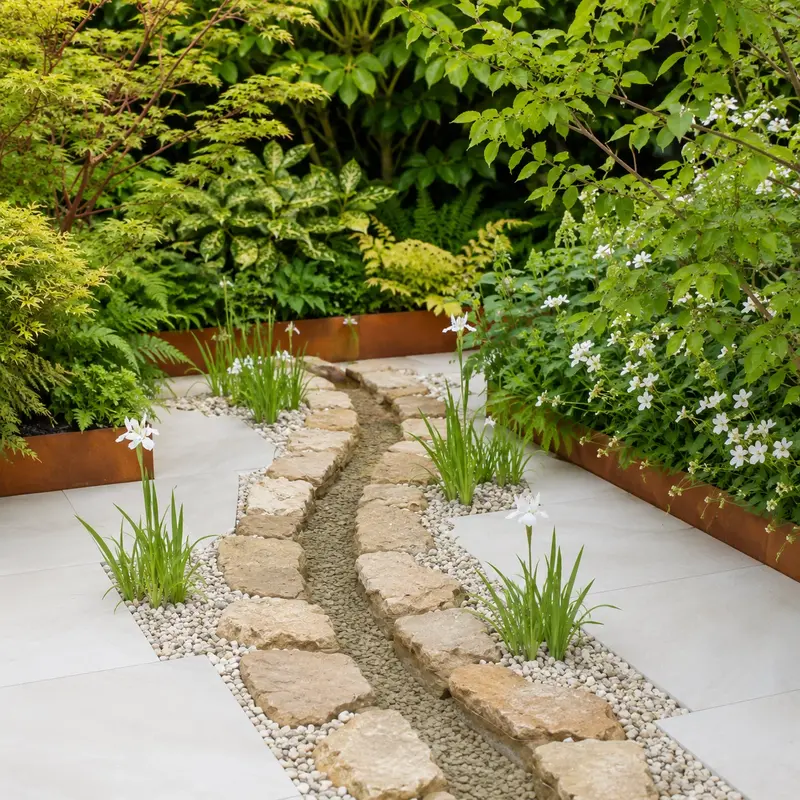
Make Empty Space Part of the Design
Empty space can be just as important as the planting itself.
Although, this idea is sometimes a bit difficult to embrace because there is a temptation to fill every available part of a garden.
However, leaving a bit more space around a beautiful tree or a water feature allows that element to have greater impact.
Think of it almost like the space surrounding an object in a gallery, if it is not given visual breathing room, everything begins competing for your attention.
This principle can be particularly effective in smaller sized city gardens where trying to include too much can make an already limited space feel even smaller.
A carefully positioned feature that is surrounded by deliberately restrained planting may have considerably more impact than filling every square metre.
Create a Sense of Journey
A garden does not need to reveal absolutely everything straight away.
Japanese gardens will regularly use pathways, planting, screens and changes in direction to control what you see as you move through the space.
This creates discovery.
Rather than standing at the back door and seeing every single feature right away, you might catch a small glimpse of something further into the garden that encourages you to explore a bit further. Thinking carefully about your garden layout can help you control these views, create different areas and influence how people naturally move through the space.
How Can You Create This Effect at Home?
Consider whether a path really needs to travel directly from one point to another, as a gentle change to its direction can alter how you experience the garden.
Planting can also partially obscure a seating area, sculpture or water feature, allowing it to be discovered more gradually.
Using this principle can be very effective when used in longer gardens, where dividing the space visually can make the garden feel a bit more interesting and expansive.
Use Water with Purpose
Water is strongly associated with Japanese garden design and can introduce movement, reflection and sound.
A pond may reflect surrounding planting and sky. Flowing water introduces gentle sound, while a still surface can create a completely different sense of calm.
You do not necessarily need a large pond, as a smaller water feature can also achieve a very similar effect when its scale and position suit the garden.
Water can even be represented symbolically. Gravel and stone have traditionally been used to suggest rivers and oceans without actually requiring any real water.
For a contemporary British garden, the important lesson here is to give water a purpose within the design rather than just treating a water feature as decoration that has simply been added afterwards.
Use Stone to Give the Garden Structure
Rocks and stone can provide a sense of permanence.
Within Japanese garden design, their placement will have been very carefully considered. Different sizes, shapes and orientations can create compositions that feel as though they belong naturally within the landscape.
This is another principle that translates very well into contemporary garden design.
Stone can be incorporated through:
- Paving
- Steps
- Gravel
- Individual feature stones
- Walls
- Edging
- Paths
The choice of material really matters here, as using too many unrelated types of stone can make a garden feel a bit fragmented. Repeating materials or selecting stone that complements the architecture of the property will help to create a much stronger connection between house and garden.
Choose Plants for Form as Well as Flowers
Japanese inspired planting demonstrates that a beautiful garden does not need to completely depend on just flowers.
Foliage and texture, along with seasonal change are just as important.
Trees and shrubs can provide the underlying structure, while lower planting creates layers beneath them.
Japanese maples are a very obvious example because of their elegant form and spectacular autumn colour, but you do not need to fill a garden with recognisably Japanese plants.
The principle can instead be applied using species suited to your own conditions.
A beautifully shaped tree, ornamental grasses, ferns, evergreen shrubs and carefully selected perennials can create a similar emphasis on form and texture while feeling entirely appropriate within a Norfolk garden.
Many of these same ideas can also be applied when designing a woodland garden, where layers of planting, foliage, texture and filtered light become important parts of the overall composition.
Frame Views Beyond Your Garden
One particularly sophisticated principle associated with Japanese garden design is the incorporation of the landscape beyond the actual garden itself.
Rather than treating the boundary as the absolute end to the design, distant trees or architectural features can also become part of the view.
This has in the past been especially relevant to some of the larger gardens I have helped to design in rural Norfolk.
So, if your property overlooks mature woodland, some fields or an attractive looking tree in the distance, there may be no need to completely screen it off from view.
Planting and structures within the garden can instead frame that view and can make the wider landscape feel like an extension of your own space.
Even on projects that I have worked on in central Norwich, where neighbouring buildings were much closer, the same principle was still used selectively. A mature tree beyond your boundary might contribute beautifully to the garden even though it technically belongs to somebody else.
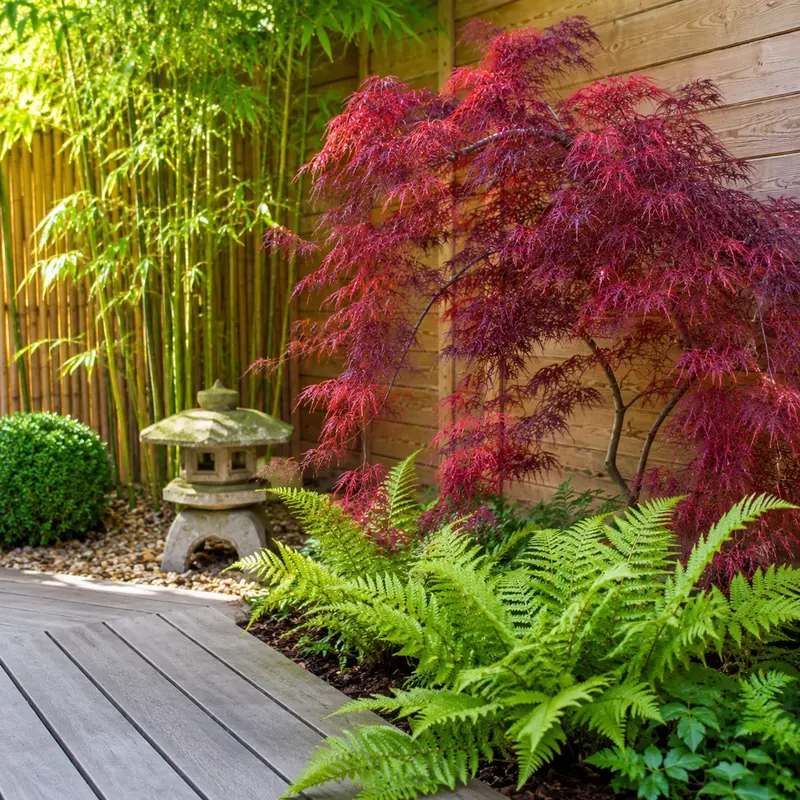
Celebrate the Changing Seasons
A garden shouldn’t only look attractive for a short few weeks in summer, a Japanese garden design usually places significant emphasis on seasonal change.
Spring blossom, fresh foliage, autumn colour and the structure of bare branches during winter can all contribute something a little bit different throughout the year.
When you get started in planning your own garden, always be sure to consider what each plant provides throughout the year.
A tree that is chosen for autumn colour might also have an elegant winter silhouette. Evergreen planting can provide structure while surrounding perennials disappear during colder months.
Thinking seasonally helps to create a garden that evolves rather than just reaching a single peak.
Avoid Creating a Japanese Themed Garden
There is an important difference between applying Japanese garden design principles and filling a garden with objects that are associated with Japan.
Lanterns, bamboo screens and ornamental features can quickly become a bit too literal when they are being used without any clear design purpose.
Instead, always make sure that you consider what actually attracted you to Japanese gardens in the first place.
Is it the calm atmosphere? The restrained planting? The relationship between stone and water? The beautiful trees? The sense of discovery?
Once you understand that well, you can then incorporate the underlying principle without creating a themed garden.
For many contemporary homes, this subtler interpretation will age much better.
How Can Japanese Garden Design Principles Work in a Norwich or Norfolk Garden?
The most successful garden should still feel like it is connected to its location.
A smaller garden in the golden triangle in Norwich will have different proportions, views and surroundings from a larger countryside property near the Norfolk broads.
Rather than imposing a Japanese aesthetic on either space, principles such as restraint, asymmetry, framed views and seasonal planting can be adapted to the individual setting.
At Chris Deakin Garden Design, the wider architecture and landscape of the client’s property are considered together when creating a garden. Inspiration can come from many places, but the finished space should feel as though it belongs to the property.
That might mean using Japanese ideas about balance and simplicity within a highly contemporary garden, or introducing a sense of journey and naturalistic planting into a more traditional Norfolk setting.
The influence does not need to be immediately obvious to be effective.
Creating a Garden That Feels Calm and Considered
Perhaps the greatest lesson we can take from Japanese garden design is that good gardens are about more than individual features, they are about relationships.
The relationship between planting and architecture. Between open and enclosed spaces. Between light and shade. Between what is immediately visible and what is gradually being revealed.
Japanese garden design principles encourage us to slow down and carefully consider these relationships rather than simply asking what else can be added.
Whether you have a compact courtyard or a substantial landscape, ideas such as restraint, asymmetry, seasonal interest and thoughtful use of space can help create a garden that feels both beautiful and composed.
Chris Deakin Garden Design creates bespoke gardens in Norwich, Norfolk and further afield, drawing on decades of garden and landscape design experience to create spaces shaped around their individual setting and the people who use them.
Frequently Asked Questions
What are the key principles of Japanese garden design?
Important Japanese garden design principles include asymmetry, simplicity, restraint, careful use of empty space, natural materials, seasonal change, framed views and creating a sense of journey through the garden.
Can I use Japanese garden design principles in a small garden?
Yes. Principles such as simplicity, carefully framed views and restraint can be particularly effective in small gardens. Avoiding unnecessary clutter can also help a compact space feel calmer and more spacious.
Do I need Japanese plants to create a Japanese inspired garden?
No. You can apply Japanese design principles using plants suited to your local climate and garden conditions. Form, foliage, texture and seasonal interest are often more important than where a particular species originates.
What plants work well in a Japanese inspired garden?
Japanese maples, ferns, ornamental grasses and carefully shaped evergreen shrubs can all work well. However, your choices should ultimately reflect your soil, available light, garden style and local growing conditions.
Does a Japanese garden need water?
No. Water is a traditional element of many Japanese gardens, but it is not essential. Stone and gravel can also be used to suggest movement and water symbolically.
How do you make a garden feel more peaceful?
Limiting the number of competing materials and features can help. Thoughtful planting, subtle screening, water, carefully positioned seating and leaving some areas deliberately open can all contribute to a calmer atmosphere.
Can Japanese design principles work in a traditional Norfolk garden?
Yes. They do not have to result in an obviously Japanese looking garden. Principles such as asymmetry, seasonal interest, natural materials and framing views can be interpreted in ways that complement traditional Norfolk properties and landscapes.
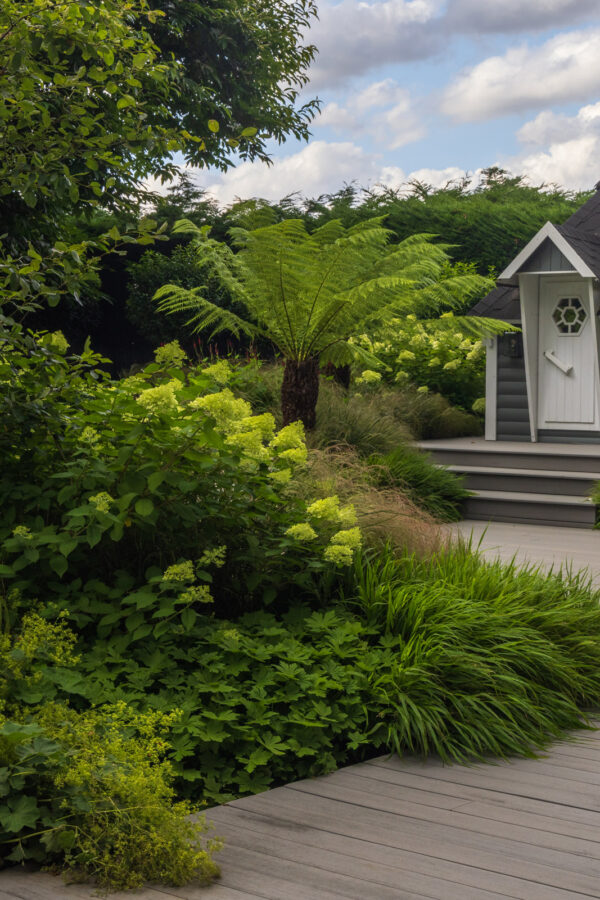
Norfolk Woodland Garden
This beautiful family home on the edge of Norwich, was built amongst a number of wonderfully established trees, giving the site a woodland feel.
Read More
Suffolk Contemporary Cottage Garden
A contemporary retreat blending tradition with modern design.
Read More
Norfolk Contemporary Flint House
A beautiful, contemporary flint house situated in a small village in North Norfolk
Read More
Norfolk House in the Norfolk Broads
Beautiful thatched, brick farmhouse, situated in the heart of the Norfolk Broads.
Read More